
At home with him, you spend cocooning evenings, family afternoons and Sunday afternoon naps. In short, he means a lot to you. And then, a moment’s inattention, a clumsy gesture and it’s drama. A spilt coffee, a felt-tip stroke from the youngest and there you have it, your beloved sofa stained. Well, let’s keep calm and look together at the tips for saving your sofa, cleaning it and making it as beautiful as when you took it out of the box.
Cleaning and caring for a leather sofa
A leather sofa requires a lot of love, but we’re sure you’ll be able to give it that. It also requires a bit of maintenance, cleaning and, as you’ll see, half the contents of your bathroom.
Oh yes, another thing we don’t always realise, but the location of the sofa is important. If it’s exposed to direct sunlight, the leather will dry out. You should also avoid putting it too close to the fireplace or a radiator to avoid cracking the leather.
Regularly, we gently dust the sofa, and not just with anything – a slightly dampened chamois, please. Then, once a month, we apply a make-up remover or a nourishing baby lotion with a soft cloth to deeply moisturise and leave it as soft as a baby’s bottom. For a deeper clean, add white vinegar. To revive the condition of leather, Marseille soap works wonders.
For stains, as for fabric sofas, don’t wait a second to clean! The 1st rule is never to rub leather, otherwise you’ll damage it. Likewise, don’t get it too wet, as water can stain it. The best thing is to do a test on an inconspicuous part of the leather to see if it can withstand the treatment.
Pen stains? Rub with a cotton bud soaked in water and 90°C alcohol. This is super effective for stains from sweet foods, alcohol, coffee or tea. Spilled paint or stained clothes: spray hairspray to dilute the stain (we told you you could find everything in your bathroom), then rub until it disappears. A trace of nail polish? Don’t use nail polish remover, use pure acetone diluted in water.
For greasy stains such as oil: apply Vaseline and leave to stand, then remove with a cloth and absorb excess with talcum powder. On old stains: use a hair dryer to dissolve them and bring them to the surface of the leather. For an unpleasant smell, sprinkle baking soda on the surface and leave for several hours.
Cleaning and caring for a fabric sofa

Whether your sofa is made of cotton, viscose, synthetic, wool or linen, you need to pamper it regularly to keep it looking its best for longer. In fact, the type of fabric is an important criterion for choosing a fabric sofa, depending on the type of care you’re looking for. Sunday: cleaning day at home, so we take advantage of being in the living room to vacuum the sofa with the brush attachment or the hose to clean it thoroughly. When it comes to stains, it’s a different story. First of all, don’t waste any time: you have to act as quickly as possible to prevent the stain from setting in! The first thing to do is to blot with a damp cloth or sponge, without rubbing the fabric. Does your fabric sofa have removable covers? That’s good news, because it means cleaning your fabric sofa will be easier to get rid of the stain.
Step 2: Read the labels on the sofa – they’ve got some interesting info on them. (Grab your glasses, sometimes it’s written very small). You’ll know whether you can clean your fabric sofa yourself, or whether you need to take a trip to the local dry cleaners with your slipcovers under your arm.
Can you clean it yourself? Great! Machine washable? Extra! Just select a suitable program (wool, delicate with minimal spinning). Then air-dry if possible. Certainly not in the dryer! That would shrink the sofa cover and you’d have to buy a new one, or a whole new sofa, and that’s not very good for the planet.
Another situation: your sofa doesn’t have removable covers. Well, you’re going to have to get your little arms out and do a bit of work to remove the stain. Can you clean with water? Use a special cleaner or our grandmothers’ favorite products: the famous Marseille soap or black soap. Apply the product with a soft brush or sponge and never, oh never, apply it directly to the fabric.
And then, depending on the stain, here are the products that will save your life:
- White vinegar: It doesn’t smell very good, we agree, but it’s top of the range on drink, soil or food stains. Mix 500ml of white vinegar with 200ml of lukewarm water and a tablespoon of washing-up liquid and you’ve got the magic liquid to get rid of that unsightly stain.
- Ammonia: We’re not going to hide it from you, ammonia is a bit harmful, so take precautions, with protective gloves, a mask and plenty of air afterwards. And don’t light a cigarette next to it! This product is top notch on body stains such as blood, urine etc. Put a few drops in a bowl of warm water with washing-up liquid and apply.
- Your sofa doesn’t like water? Sprinkle bicarbonate soda on the fabric, wait an hour and vacuum. Colors are revived and the sofa smells great! Perfect for greasy stains on fabric sofas.
Then, rinse gently with a damp sponge, avoiding soaking the fabric to prevent streaks. Dry with a hair dryer (not too hot, we’re not here to blow-dry) or a towel.
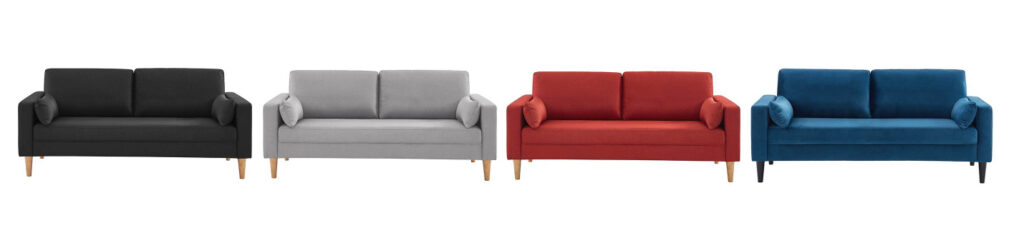
Cleaning and caring for a microfibre sofa
The basic rule for a microfibre sofa is to dust it regularly with your vacuum cleaner. To give it a new look, clean it from time to time with a cloth dampened in lukewarm water and a little liquid soap, such as Marseille soap. You can then dry it with a hair dryer.
Has your beautiful sofa been stained and Marseille soap isn’t enough to get rid of it? Don’t panic, there are other, more specific cleaning products to get rid of it.
- 70° alcohol is ideal for removing grease stains. Dab the stain with a cloth soaked in cold water and alcohol, then dry.
- White vinegar is easy to use and can be used to remove stubborn stains from fabric, making it highly effective against wine, for example. Mix with warm water and rub over the stain. Rinse quickly to avoid creating a white halo.
- Bicarbonate soda: Before using baking soda, test it on a small area of fabric to be sure it’s safe. Apply the paste formed from bicarbonate soda and a little water to the stain and leave to dry. Rinse and your sofa will be as good as new!
- Soda crystals are even more powerful than bicarbonate. They’ll be very useful for removing cat urine odors or brightening up yellowed white fabric. Don’t forget to put on your cleaning gloves when handling this product, and measure out as indicated on the packaging. Dab the mixture onto the stain and rinse with clear water.
Cleaning and caring for a suede sofa
We advise you to maintain your suede sofa regularly, otherwise it will quickly become damaged. You can rub it lightly with a brush or a special suede eraser. Certain stain-repellent products are available for sale, to slow down the rate at which stains become embedded in the fabric.
There’s nothing complicated about cleaning a suede sofa! The trick is to do it without damaging the material, and that’s another story. Generally speaking, cleaning with a soft brush slightly dampened with lukewarm water is enough. But some stains are a little more stubborn, so here’s how to neutralise them.
- For water stains, a soft brush and diluted white vinegar are your best allies.
- Grease stains are harder to remove from suede. To give yourself the best chance, we recommend rubbing with a cloth and baking soda. If the stain persists despite your best efforts, you can try diluted ammonia, but be careful.
Cleaning and caring for a velvet sofa
Having a velvet sofa means almost daily maintenance, as this material easily catches hairs and dust. Get yourself a velvet sofa brush – it’ll come in very handy! Simply brush the material gently to remove dust. Vacuuming is also an option, but use a special nozzle and be gentle so as not to damage the surface. Absolutely avoid using a damp cloth or sponge, which could damage the fabric.

The 1st thing to do before cleaning your sofa is to check with the manufacturer, as different types of velvet require different cleaning methods.
- Silk velvet requires dry cleaning
- Cotton velvet can be cleaned with water. Don’t forget to test your product on a small hidden part of the sofa before using it on the whole.
For a cotton velvet sofa, you can mix a little soapy water and white vinegar and apply the mixture with a slightly damp cloth. Rub gently and dry with a paper towel to remove moisture before streaking. Instead of white vinegar, you can also use baking soda and lemon juice.
If your model requires dry-cleaning, you can use some ‘Terre de Sommières’, a natural product that’s quick and easy to use. Put on your gloves and pour a little ‘Terre de Sommières’ on the sofa, rubbing gently with your hand so that the material absorbs the product. Leave overnight and vacuum the sofa. Instead of ‘Terre de Sommières’, you can also use talcum powder, the method of application being exactly the same.
If your velvet sofa has removable covers, you can machine-clean it, but be sure to check the instructions for your model.
Cleaning and caring for a nubuck sofa
Nubuck is a soft-touch, matte leather. Over the years, stains and shiny wear marks can appear. To prevent them, vacuum and brush your nubuck sofa. An eraser designed for suede can also do the trick. You can clean it gently with a sponge and a little soapy water. For grease stains, there are two possible methods. Mix a little soapy water with a few drops of ammonia and scrub with a brush. You can also use talcum powder or ‘Te”rre de Sommières’. To clean a heavily soiled nubuck sofa, opt for a crepe brush and a mixture of half water and half ammonia. Dry thoroughly when finished.
If shiny patches appear on your sofa, the trick is to use very fine-grain sandpaper and rub gently.
Cleaning and caring for a suedette sofa
On each suedette sofa, you’ll find a letter that tells you how to care for your sofa. The W means use water, the S indicates cleaning with chemicals such as solvents. The 2 letters can also be combined. Machine washing may also be indicated.
Before you start cleaning your sofa, give it a quick vacuuming to remove any dust. To eliminate unpleasant odours, you can apply washing powder or bicarbonate soda. All you have to do is vacuum to remove any residue.
For more specific care, apply the product to the stain using a spray bottle. Using a colorless cloth, gently wipe the different areas with circular movements. Use another cloth to dry the product.
White vinegar is also a highly effective stain remover.
Whatever cleaning product you use, don’t forget to carry out a test on an area of your sofa.
Cleaning and caring for a boucle fabric sofa
To keep your boucle fabric sofa clean, remember to vacuum it once a week with a soft brush to avoid damaging the fabric. This will remove all dust. You can also use an adhesive roller to remove small dust particles or pet hairs trapped between the fibers. A soft-bristled clothes brush can also be used. For cushions, you can shake them in your garden to remove dust. Alternatively, a steam cleaner is a very effective way of removing dust.
Have you spilled a liquid on your boucle fabric sofa? Don’t panic, use a dry cloth to soak up the liquid, followed by a special sofa cleaner or simply warm water and soap. Apply in a circular motion, then rinse with a damp cloth and leave to dry.
To keep your boucle fabric sofa in good condition for as long as possible, protect it with plaids or slipcovers. As a preventive measure, you can use an anti-stain product to make the fabric more resistant to minor accidents. Last but not least, to prevent the fabric from fading, avoid placing it near a window where sunlight could cause discoloration.
To finish on a high note, here are a few important rules to follow with your microfibre sofa. Avoid corrosive products that could damage your fabric and cause stains that won’t come out. Never apply the product directly to the sofa; use a cloth or a towel. Start by testing the product on a small area of the sofa to make sure it’s right for it.
With all this, we hope you’ll be able to take good care of your fabric or leather sofa, and that it will be able to take pride of place in the middle of your living room for a long time to come.