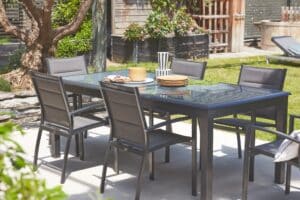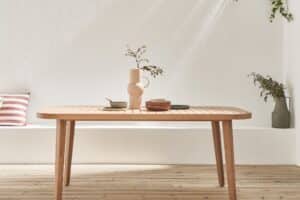
Garden tables come in a wide variety of materials, each with its own advantages and disadvantages. It is important to choose a material that suits your needs, your lifestyle and your living environment. Some materials require more maintenance than others, so your choice of table will depend on how much time you are willing to spend cleaning it. If you have a large family and regularly eat outdoors, your table will see a lot of use. In this case, opt for a garden table made from a very sturdy, durable and easy-to-clean material. The table should be chosen based on your geographical location; indeed, if you live in an area prone to harsh weather, choose a table that is rust-resistant.
The wooden garden table
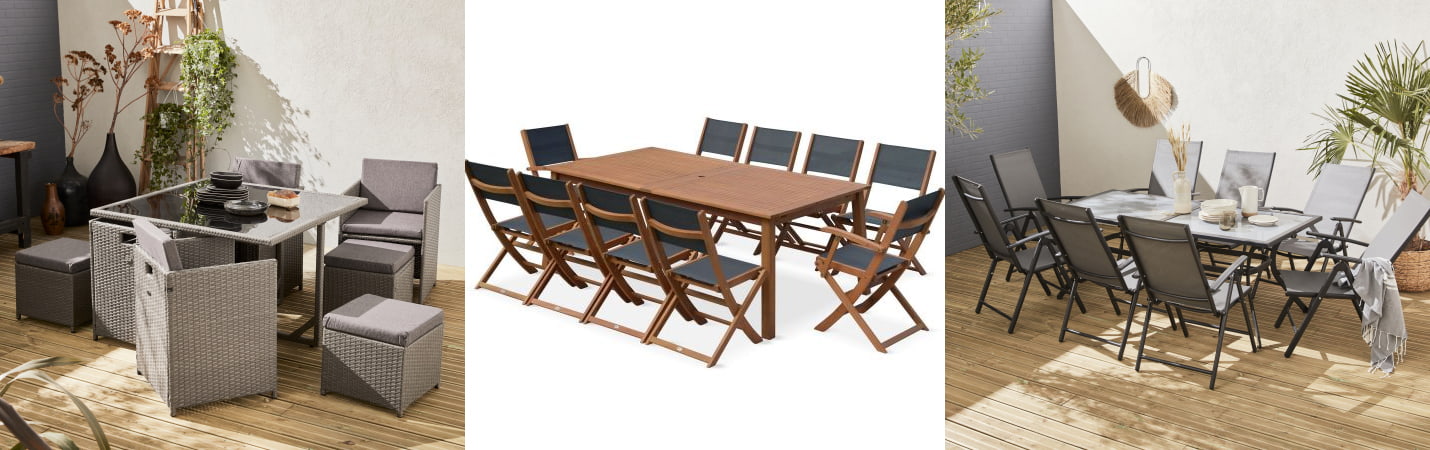
Wood brings a natural and exotic feel to your garden sofa; it comes in a range of colours, from light to dark, depending on its origin. Teak, acacia and eucalyptus all have different characteristics, so choose according to the colour and durability you’re looking for. Wooden furniture is among the most durable materials: it can last for around 15 years if well maintained. Wooden furniture will add a warm touch to your garden.
This material is also far more environmentally friendly than synthetic materials, as it is biodegradable. Furthermore, some timber comes from sustainably managed forests. The most popular types of timber are:
Teak: This is the most weather- and insect-resistant type of wood. It is also the most expensive and heaviest type of wood. It is very durable and of high quality, but requires more rigorous maintenance than other types of wood.
Acacia: this wood is the best alternative to teak as it is cheaper, lighter and moisture-resistant.
Eucalyptus is one of the less expensive woods, but it is also less durable than teak or acacia. It is often a reddish-brown colour, which makes it easy to recognise.
Garden tables often have a hole in the centre to allow a parasol to be placed there, providing good shelter from the sun. There are also many extendable wooden tables, which is less common with resin-woven garden tables. Furthermore, wooden garden furniture is also insulating and will feel cooler to the touch than metal furniture, for example.
The plastic garden table
Plastic is the most economical material, as it is one of the least expensive. A plastic garden table is available in a wide range of colours, designs and shapes. It is easy to move around thanks to its light weight, but is also stackable and weather-resistant. Very easy to clean, plastic is one of the most commonly used materials for garden furniture.
Over the years, it has become fashionable and no longer has a reputation for being unattractive. Its main advantage is that it is easy to clean, whether it’s dealing with stains or simply dust. On the other hand, plastic tends to be fragile and can break, so it doesn’t last very long.
The woven resin garden table
Woven resin is a highly sought-after material; stylish and subtle, it complements a range of design trends. Its light weight makes it extremely practical and easy to move around. Woven resin garden tables come in a variety of shapes and colours. This material is highly resistant to wear and tear caused by the weather, as well as to both cold and heat. It is resistant to chlorine and UV rays and does not fade. Often topped with a glass panel, the woven resin garden table is the trendy choice! The only downside is that woven resin tables and chairs tend to be bulky.
The rattan garden table
Rattan is very similar to woven resin, but it is made from natural vine fibres native to Asia. The rattan weaving technique makes for very sturdy furniture that often retains its natural colour. However, rattan remains quite sensitive to weather conditions. We recommend not leaving it in direct sunlight for long periods, as this may cause it to fade. Damp and rain tend to warp it due to the fibres swelling.
The wrought-iron garden table
Wrought iron is the ideal material for those who love retro tables with a rustic, romantic style. It is perfect for windy areas as it is a heavy material that ensures good stability. Thanks to its anti-corrosion treatment, this material has a lifespan of around 20 years.
Garden tables made of steel and aluminium
Aluminium is three times lighter than steel and adds a touch of modernity to your garden or patio. An aluminium garden table is weather-resistant and won’t rust. What’s more, it’s easy to maintain and can be left outside over winter without any problems, though we do recommend covering it. The downside of aluminium is that it heats up very quickly in the sun and can become scorching hot in high temperatures.
Steel gives it that industrial look that’s very much in vogue at the moment. It is waterproof and impact-resistant. It offers good quality at an affordable price. Steel is usually coated with a rust-resistant paint.
The natural stone or marble garden table
A stone table has the advantage of being able to be made to measure, whether thin or thick. It adds character to garden furniture. A stone table is very heavy, which ensures it remains stable in strong winds and bad weather.
Choosing materials based on your environment
When choosing your garden table, the mistake to avoid is opting for the same material as your patio flooring. For example, if you have a wooden slatted patio, avoid choosing a wooden table – particularly one in the same colour – to prevent the look from becoming too overwhelming. Consider the alternatives available to you, such as woven resin, which suits all styles and gives the space a modern feel.
If you have a large garden, go for a natural, rustic look with a wooden or wrought-iron table and some colourful cushions. You should also choose a sturdy material that can withstand any insects you might find in your garden.
For those lucky enough to have a swimming pool, it’s best to choose a table that can withstand water and damp. For this reason, we recommend plastic or aluminium tables.