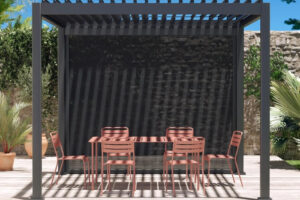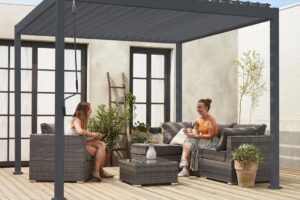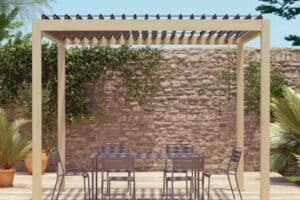
When the warm weather arrives, we all want to sit on our terrace and enjoy a good book while basking in the warmth of the sun’s rays. But how can we enjoy our outdoor space during the other seasons? How can we enjoy our terrace when it’s raining, windy or during heatwaves? An increasingly popular solution for homeowners is to invest in a louvered pergola! Shade in summer, light in winter, a terrace sheltered from the elements… Louvered pergolas offer many advantages. But why invest in a so-called ‘louvered’ pergola rather than a traditional one? And how do you install and maintain it? sweeek’s advice will guide you by answering these many questions and explaining the various advantages and disadvantages of this type of installation.

What is a louvered pergola?
Pergolas were originally spaces sheltered from the sun by slats or climbing plants, providing a pleasant place to take refuge on hot summer days. Often attached to the house, but also suitable for placement in the garden, for example next to a swimming pool, the pergola is an ideal outdoor living space for lunch during the summer season.
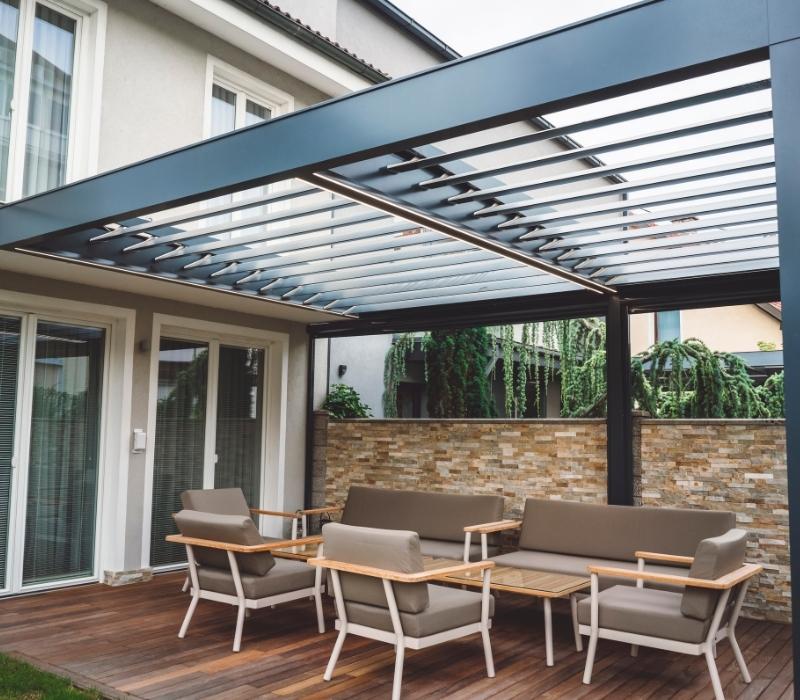
On the other hand, louvered pergolas, although serving the same purpose as a traditional pergola, allow you to adjust the shutters that form the roof, ensuring optimal efficiency whatever the season.
In other words, the aluminium or wooden slats of the pergola can be automatically adjusted to suit your needs (shade, light, coolness, etc.) and some even close automatically as soon as the first drops of rain fall! This system of adjustable slats filters the sun’s rays to provide coolness and shade on hot summer days, for example.
An ideal replacement for traditional blinds or gazebos, pergolas are becoming increasingly popular for protecting outdoor terraces. Although more expensive and imposing, louvered pergolas appeal due to their multiple functions and year-round usefulness.
How to choose a louvered pergola?
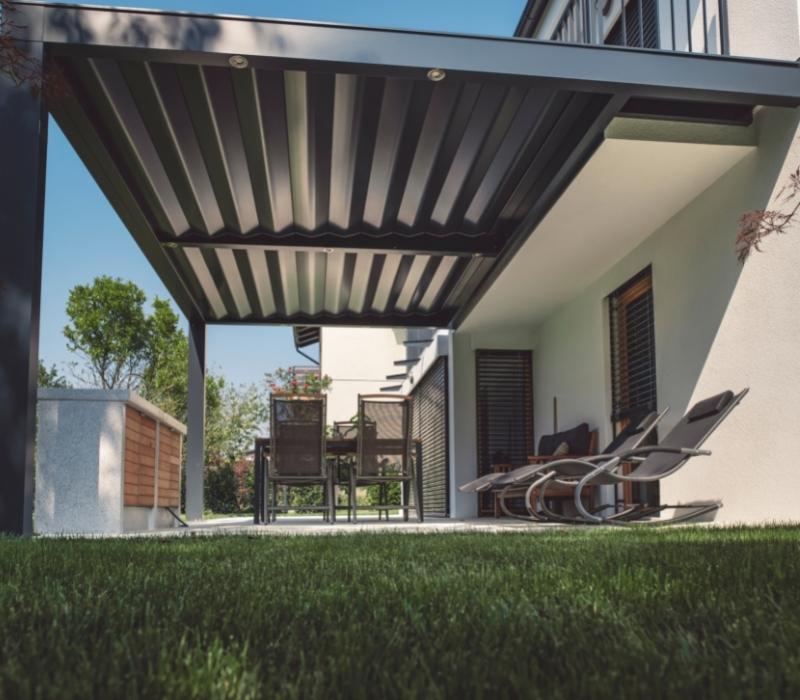
A true feature in its own right in the garden, you need to choose your louvered pergola with care and attention to ensure it best suits your home and your desires. There are several criteria to consider when choosing your pergola, so follow our guide!
- The slats: undoubtedly the most important elements of a louvered pergola, the slats are made of wood or aluminium and come in a variety of styles. Pergolas with adjustable slats are perfect for protecting you from the sun’s rays or bad weather in all seasons. There are also louvered pergolas whose slats are not only adjustable but also retractable. These offer the same advantages as simple adjustable shutters but can also be retracted like an awning to allow you to enjoy the blue sky to the full.
- Freestanding or attached: a freestanding pergola is a separate structure in the garden supported by four or six pillars. Strong and durable, freestanding pergolas are generally popular beside swimming pools. Wall-mounted pergolas, on the other hand, are fixed to the façade of the house and create an extension of it, providing a real outdoor living space!
- Other criteria to consider: when choosing between all the models, opt for a good quality pergola that will withstand the elements as well as possible. A sturdy and durable aluminium structure will do the job perfectly and guarantee comfort and quality. In addition to combining aesthetics and design, this type of structure will withstand rust and wear and tear very well. Size is also important depending on the space you have available: at sweeek, we offer 3×3, 4×3 and 6×3 louvered pergolas. Also check that the pergola roof is watertight when the slats are closed: this will ensure that your model is effective whatever the season.
What are the advantages of a louvered pergola?
There are many reasons to invest in a climate-controlled pergola. First, as explained earlier, having a ‘louvered’ model allows you to make the most of the climate’s natural resources (light and heat) while protecting yourself from negative aspects such as rain, cold, wind, etc. When the sun is shining, the pergola provides a shaded and ventilated refuge. Conversely, when it rains, you can store your garden furniture underneath the closed slats, which retain rainwater.
In addition, a pergola can serve as an outdoor room when attached to the house, or as a real living space if it is located in the middle of the garden or near a swimming pool. By opening the slats, you can also enjoy ideal natural light and reduce your energy consumption. A pergola has a long lifespan and is very wind-resistant, unlike traditional blinds.
In terms of aesthetics, pergolas offer several major advantages. You can choose from dozens of louvered pergola models with different designs, colours, materials and accessories. It is now also possible to install a whole range of customised accessories on your pergola (sound system, sliding blinds, lighting system, etc.) for optimal comfort and to turn your pergola into a real indoor living space.
In terms of project costs and material prices, building a pergola is less expensive than building a sunroom or conservatory, for example. A sunroom and conservatory are, in fact, a separate room within the home, and the cost estimates are therefore much higher than for installing a pergola. Good to know: if you already have a pergola without a roof, the adjustable slat system can be installed very easily for added comfort.
What are the disadvantages of a louvered pergola?
A louvered pergola has a few disadvantages, although they are few and far between. Building a pergola attached to the façade of a wooden house can be complicated, given its very high weight (between 400 and 500 kg). Furthermore, the cost estimate and the relative complexity of the project can be obstacles to investing in a pergola.
How to install and maintain a louvered pergola?
To determine where to install a louvered pergola, first check the condition of the facade on which the structure will be mounted. It must be in good condition to support the 500 kg weight of the pergola. If your pergola is custom-made and freestanding, i.e. away from the house, you will need to check the stability of the ground. The most common advice is to examine all possible solutions in order to find the ideal location for your pergola.
Unlike a gazebo, which can be set up anywhere, installing a louvered pergola requires careful consideration. It is important to study the orientation in relation to the sun, the direction of the prevailing winds and the shaded areas of the garden in order to install the pergola in the ideal location to make the most of natural light!
In terms of maintenance, a louvered pergola does not require any special attention apart from cleaning the gutters and aluminium slats with soapy water. However, be sure to close the adjustable slats (if they are not automatic) during heavy rain to keep the interior dry.

How much does a louvered pergola cost?
It is important to note that installing a large structure such as a louvered pergola will result in a fairly high quote. This price varies depending on various criteria such as the size of the installation, the quality of the materials chosen and any custom accessories added. Each additional feature will inevitably increase the total cost. However, for a ‘classic’ model, you can expect to pay around £5,250 for a 12m² pergola. There are also more affordable models starting at £2,600 with wooden or canvas slats, similar to an awning. A high-end pergola will be similar in price to a conservatory and will cost between £10,000 and £14,000. It is possible to add other expensive options, such as replacing the aluminium or wooden slats with translucent glass slats for maximum light.
We have now reached the end of this guide to louvered pergolas, and we hope that it has been useful in helping you find that rare gem that will be the solution to all your design needs.